Write for us!
The continuing existence of the United Nations Relief and Works Agency for Palestine Refugees is in doubt. The UK is uniquely placed to take the initiative.
I’d like to start with a question, one I put to some friends last week when, given that so many States are happy to disregard it, they scoffed at the so-called international rules-based order. ‘Would you prefer to live in a world bereft of even the most basic rules of conduct,’ I asked, ‘or would you prefer the body of international law to exist, even if so many States violate it with impunity?’ My friends laughed and agreed the latter was preferable (sort of).
Most of us, certainly Party members, would not only support the latter view but feel an obligation to do what we could to uphold the authority of international institutions. Looking at the Ukraine, Palestine, Sudan and now Iran, to name the more obvious cases in the news, we can see that the survival of the United Nations and its constituent institutions is currently in greater doubt than ever.
As an opposition party we need to be practical and focused if we wish to influence UK policy, and for that reason I wish to draw attention to the existential crisis for UNRWA (The United Nations Relief and Works Agency for Palestine Refugees). It offers us a clear opportunity to argue for something of real importance and solid value.
The current status of UNRWA is critical
Saving UNRWA is now critically urgent. Founded in 1949, after the first Arab-Israeli war, when 750,000 Palestinians were expelled from their homes and livelihoods in what is now Israel, UNRWA is a humanitarian agency which principally provides quasi-governmental services to refugees not only in the post-1967 Occupied Palestinian Territory (oPt) (1.6 million in Gaza, 1 million in the West Bank) but also to refugees in Lebanon, Syria and Jordan (another 3.5 million), roughly six million in all. It employs roughly 30,000 teachers, health professionals, etc. to achieve this. But these official statistics ignore the help UNRWA has also been compelled to provide to starving Palestinians who are not refugees but who are desperate for help in Gaza. And to be truthful, UNRWA has never had the budget it needs to do the job properly for a very simple reason. From the outset, when it was imagined peace could soon be achieved and it would no longer need to exist, UNRWA has depended on voluntary contributions from Member States. A small group of these, led by the US, did the financial ‘heavy lifting’. Quite a few States gave nothing, despite consistently voting for a renewal of UNRWA’s mandate in the UN General Assembly. Given an inadequate income, UNRWA routinely had to cut its planned activities. I know this at first hand, since I was responsible for soliciting UNRWA’s funding in the late 1970s, when things were so much easier than now. Today UNRWA desperately tries to meet the basic services at a cost, if my maths is correct, of around $450 per head per annum, or $8.60 each per week for food rations, public hygiene, health and education, to name the more obvious services. It’s an astonishing achievement.
The UN is divided
Imagine our lives here if we were to undergo not only widespread destruction of habitat (and were sheltered in crowded tents, as in Gaza), but with the government services we chiefly rely on: our health, education, and basic services like sewerage and food aid, largely taken away, with little prospect of restoration. This is what may be at stake for millions if we cannot persuade the United Kingdom to take a leadership role internationally in securing UNRWA’s future.
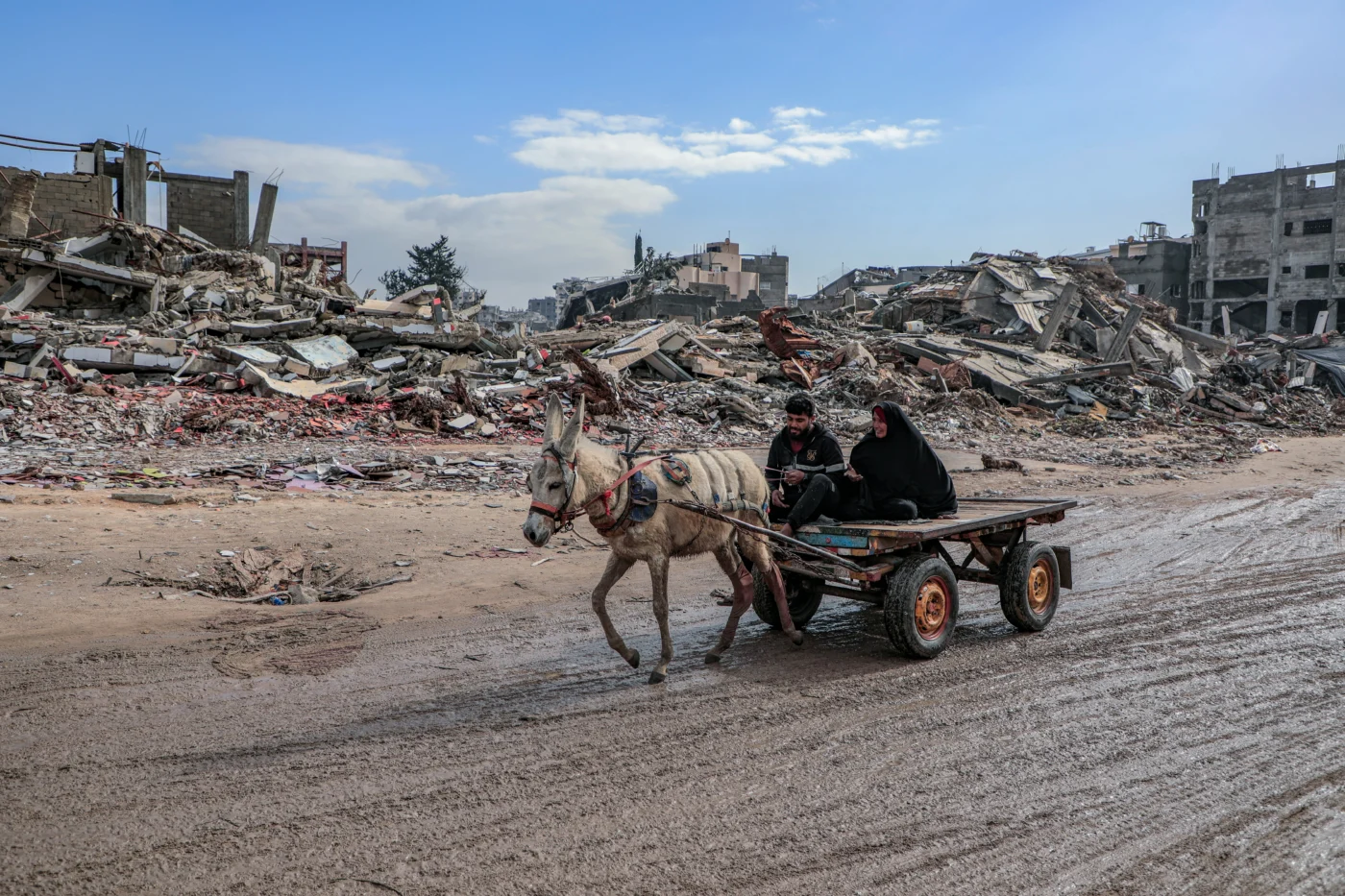
UNRWA, like all UN agencies, should enjoy the respect and support of all UN Member States, but it doesn’t. Since 2023 it has come under three forms of major assault from Israel in the oPt that directly threaten its survival. First, over 400 UNRWA staff have been killed, over 300 schools and other buildings destroyed, many of its charges also killed, since Israel’s assault on Gaza. Secondly, it has faced a determined legal assault designed to close UNRWA down in the oPt, including confiscation of UN property and the systemic stripping of UN staff of their international immunities, privileges and freedom of movement. Thirdly, it has come under moral assault, accused by Israel of complicity in the Hamas October atrocity, although not a shred of credible evidence has ever been produced. The damage from this baseless accusation has been enormous. No fewer than 16 donor Member States, including the UK, took fright and suspended donations at precisely UNRWA’s and the refugees’ moment of most extreme need. In retrospect, it was simply incredible behaviour.
Israel’s actions have compounded the crisis
Israel has mounted a planned assault on UNRWA, aimed not only at destroying its severely reduced ability to serve the refugee population but, more ominously, at destroying the rights and legal status of Palestine refugees, which UNRWA embodies and upholds. In so doing, Israel has mounted a direct assault on UN General Assembly Resolution 302 (IV) which brought the Agency into being in December 1949, and thus an assault also on the authority of the UN.
The loss of US support in its entirety in 2024 following Israel’s accusations devastated UNRWA’s funding base. Although most other donors which suspended contributions have recommenced them, income is severely diminished.
Sure enough, the UN-commissioned independent review (April 2024) and subsequent International Court of Justice Advisory Opinion (October 2025) have found no evidence of wrong doing, but on the contrary, as the ICJ pointed out, the restrictions and damage inflicted on UNRWA placed a commensurate moral burden on Israel, as Occupying Power to ensure the wellbeing of the occupied population. UNRWA has in fact already been carrying out the Occupier’s legal obligations, on which it defaulted from the outset of the occupation in 1967. This in itself has been an assault on international law and the authority of the UN.
A firm foundation is needed
In the face of such adversities, UNRWA urgently needs a more robust footing. Unlike subsequently established UN agencies, UNRWA has only ever had an external Advisory Committee. But it needs an executive committee, a group of states formally committed to oversight of UNRWA, to support its work diplomatically in the field as well as in international fora and also to take responsibility for its finance, persuading Member States to contribute adequately.
The UK can play a vital role
UNRWA needs not only a formal group of committed Member States ready to take on this role, but an appropriate one to volunteer the role of leader. In the absence of the US, which Member State could be more appropriate than the UK? With an historic connection to Palestine as erstwhile League of Nations Mandatory Power and with its status as one of the Five Permanent Members of the UN Security Council, there is every reason for us to urge our government to step up to this possible leadership role, one which can greatly support stabilising the situation for 6 million Palestine refugees. It will look good internationally and it will show that it can act on behalf of Palestinians, in mitigation of the widespread belief that the UK has been complicit in the continuing ordeal in Gaza. This is the urgent message of recent briefings by the Palestine Refugee Policy Forum. The government needs to get the ball rolling in the UN General Assembly now to help secure UNRWA’s future. Finally, it might be tempting to say that after all these years, UNRWA shouldn’t really exist. Most UNRWA staff would agree but point out that it only exists because of the dispiriting failure of the international community to ensure a solution by implementing relevant international law and UN resolutions. Until leading UN Member States find the political will to execute the July 2024 ICJ Advisory Opinion on the Occupation, which the UK government (slow readers?) is apparently still studying, UNRWA will remain vital. So, let’s ensure our own government takes a lead in securing UNRWA’s future. To save UNRWA would be a significant practical step in our commitment to uphold the United Nations rules-based order.
David McDowall worked for UNRWA in the 1970s. He is the author of ‘Palestine and Israel: The Uprising and Beyond’ (IBTauris, 1989) and ‘A Modern History of the Kurds’ (IBTauris, 2021).