Write for us!
The impression most people have of the French Revolution is a one of sensible moderates who were overcome by the radical extremists of Robespierre who then drowned the Revolution in blood. Jonathan Israel doesn’t dispute that part of the story but places on center stage a group of democratic republicans who briefly gained control of the Revolution and came close to establishing the first true modern democracy – before Robespierre staged the coup that led to them being sent to the guillotine.
The Roots of the Revolution in the Radical Enlightenment
Johnathan Israel has made the Enlightenment his main specialisation. Not the Enlightenment as a whole, but a radical Enlightenment originating in the Netherlands in a circle around the Jewish philosopher Baruch Spinoza (1632 – 1677). In the 18th century a small group of philosophers sponsored by the aristocrat d’Holbach took up Spinoza’s ideas – the most famous of d’Holbach’s circle were Diderot and d’Alembert whose Encyclopedia smuggled in articles on democracy and skepticism about religion amongst less iconoclastic articles. The publication of initial volumes of the encyclopedia provoked outrage from a narrow group of clerics, though this opposition failed to gain traction. After 1756, however, things like French defeat in the Seven Years War (which needed a scapegoat) meant that the tide turned against the Encyclopedia. It was at this point that Helvetius’ book De l’esprit (On Mind) was published. Helvetius said explicitly what Diderot and d’Alembert were saying covertly.
Even though Helvetius was not part of the d’Holbach’s circle (he would be later), the outcry his book provoked soon enveloped the Encyclopedia as well. Voltaire did initially defend the Encyclopedia but not simply on the basis of free speech. Israel shows that Voltaire had an agenda – he wanted to solidify his leadership over the Philosophes. His hope was to persuade the Encyclopedists to see sense, tone things down and recognize that Enlightenment could only triumph with the help of Royal authority.
Diderot had no intention of doing any such thing. Although d’Alembert distanced himself from the project, Diderot, after the Encyclopedia was banned, carried on with the editing of the final volumes of the Encyclopedia in secret with the help of d’Holbach. He refused an offer from Frederick the Great to publish the Encyclopedia in Prussia because, had he done so, he would have lost control.
On the surface, the offer of support from such a prominent figure of the mainstream Enlightenment, and a king at that, contradicts Israel’s thesis of two opposed Enlightenments – mainstream and radical. This apparent contradiction is even more stark when we view the substantial financial support Diderot got from Catherine the Great. Although he accepted her money, this didn’t stop him writing a critique of her Nakaz – her proposal for a very limited step towards an Enlightened Russia. His opening sentence was “There is no true sovereign except the nation; there can be no true legislator except the people”. He never sent it. When Diderot died, his “Observations” was sent along with the rest of his papers to Catherine. Only then did she grasp the degree to which they differed politically.
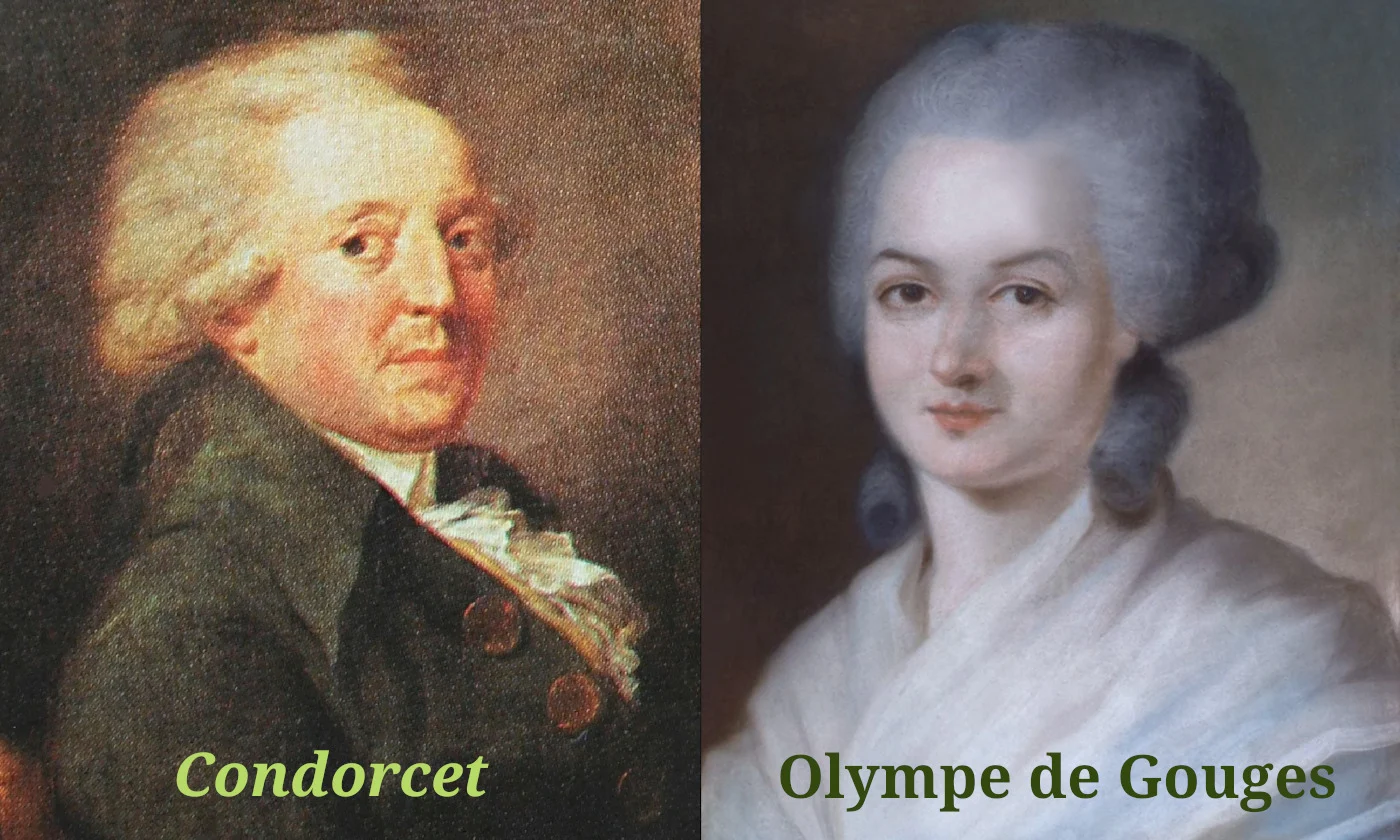
Another member of the d’Holbach circle was Condorcet, who at the time played a minor role but would go on to become a key figure in the French revolution itself and whose wife, Sophie de Grouchy, was notable for running a salon that attempted to enable women to play a role in the revolution.
The most famous member of the d’Holbach circle, Rousseau, soon fell out with them and became their most bitter opponent. He didn’t share their atheism and rejected their hopes that science would improve human life, regarding it instead as a corrupting influence. The d’Holbach circle recognized the importance of emotions, but put reason in charge, while Rousseau would at times appeal to reason but put emotions in charge. Rousseau differed from the many conservative and clerical critics who opposed the d’Holbach circle so as to defend old ideas in that his ideas were developed as an explicit rejection of the Enlightenment. As such Rousseau is often described as the founder of the Counter-Enlightenment and to me it is a pity then that Israel blurs this distinction by using the term Counter-Enlightenment for adherents of the old order who opposed the Enlightenment, whether radical or mainstream.
The Revolution Itself
This division continued into the revolution. The initial period of the Revolution was dominated by constitutional monarchists who admired the British setup – they were in the mould of Voltaire and mainstream Enlightenment. They were utterly hamstrung by Louis the Sixteenth’s refusal to play the role of a constitutional monarch. After the flight to Varennes when Louis made a dash for the frontier, hoping to return at the head of an Austrian army to reimpose absolutism, they found themselves in theory defending the executive power of the king while in practice knowing he could not be trusted.
This opened the way for the democratic republicans who had till them been marginalised most of the time. Led by people like Brissot and Condorcet they have come to be known as the Girondins because many of them come from that region of southwestern France. As the revolution became more radical a growing number of émigrés gathered near the eastern border of France with the obvious aim of counter-revolution. This was seized upon by Brissot partly because he argued that Austrian support for the émigrés indicated war was inevitable, partly because believing in democracy for all, he wanted to spread the revolution but, probably most of all, because he believed that war would deepen it. He also believed that it would result in a quick French victory and received a surprising ally in the king who was convinced the outcome would be a quick defeat and, he hoped, a restoration of absolutism. Both would be wrong, but Brissot was right about the revolution becoming more radical.
The deepening of the revolution culminated on the 10 August 1792 with an insurrection in Paris which gave the Girondins most of their program, but it was a fragile success. The August insurrection had not been led by them but by Danton and other radicals. Furthermore, the Girondins did not have a majority in the National Convention that was elected on the wider franchise. Opposing them were the populist “Mountain” led by Robespierre who are often described as far left but Jonathan Israel describes as crypto-Fascist – either way, they were certainly authoritarian.
However, while the Girondins maintained their control of the government, they did not control the legislature as the balance of power was held by “the Plain” who could be swayed either way. While Condorcet was the main force in writing the new constitution, he failed to achieve his preferred option of a directly elected collective executive. Despite this, the principle of a collective executive as opposed to a monarch or president survived (but was chosen by the legislature). He failed completely to get votes for women, as even among the Girondins there was little enthusiasm, although they did include early feminists such as Mary Wollstonecraft and Olympe de Gouges among their supporters.
Then Dumouriez, a general fighting in the Austrian Netherlands, got upset because of a lost battle and tried to stage a coup. He failed but a real conspiracy set off a cycle of paranoia that gripped Paris. In the Convention, the soon to be notorious Committee of Public Safety was set up. Finally at the end of May 1793 at the instigation of Marat and Robespierre, the Convention was besieged until they caved and agreed to hand over 22 Girondins. A few escaped but those who didn’t soon faced revolutionary tribunals where the inevitable sentence was death by guillotine. Many others, including Olympe de Gouges shared their fate. Condorcet died in prison – murder or suicide.
The Debate on the Revolution
That’s a very brief outline of the Revolution to which Jonathan Israel devoted 1000 pages of “Revolutionary Ideas”. Despite this, the book doesn’t go into much detail on what the revolutionary ideas were – it is a strictly chronological account of the Revolution viewed through the lens that it was ideas that mattered above all. That doesn’t mean he denies the importance of the economic crisis and the discontent among the poorer citizens, but he implies that this influenced events by tipping the balance between competing ideologies rather than being a truly independent factor. He makes a good case but reading “Revolutionary Ideas” alone gives the impression that the conflict was between the followers of Voltaire (constitutional monarchists), of Diderot, d’Holbach and Helvetius (the Girondins) and finally of Rousseau (Robespierre’s authoritarian populists). The problem with this is that the Girondins also quoted Rousseau. To get Israel’s answer to that, you need to read his “Democratic Enlightenment” – another 1000 pages. Jonathan Israel doesn’t do popular history.
What Israel describes in that volume is how the Girondins attempted to put into practice the reason of Diderot and Helvetius but found those ideas didn’t fully answer the crisis they were faced with – the Revolution threatened by adherents of the old order and a descent into anarchy. Hence they resorted to Rousseauist ideas despite disagreeing with much of the rest of what Rousseau wrote. Rousseau’s concept of Public Virtue seemed especially useful, making it a duty of citizens to come together to defend the new revolutionary government.
At its simplest Israel is returning to one of the earliest explanations of the Revolution, one that was uncontroversial among those who lived through or immediately after it – that its origins lay with the ideas of the Philosophes. This original take on the revolution has been under attack ever since and so to defend Israel’s thesis requires meeting those objections such as that many of the Philosophes opposed the Revolution (for example from Roland N. Stromberg 1988). Israel’s demarcation of the Philosophes into two camps with a mainstream Enlightened who put their faith in the reigning monarchs who they hoped would become Enlightened reformers is a partial reply. Of course, members of the moderate Enlightenment might be expected to oppose the Revolution. However, those who opposed the revolution (or whose neutrality can be seen as tacit disapproval) include also members of the radical Enlightened.
But if those members of the radical Enlightenment who did support the Revolution found themselves having to compromise their principles, by adopting too much from Rousseau, then it is hardly surprising that as many chose to avoid that compromise.
On the other extreme, Marisa Linton’s “Choosing Terror: Virtue, Friendship and Authenticity in the French Revolution”, takes the line that in their obsession with virtue (she avoids mentioning that the source of that obsession was Rousseau) all the leaders were as bad as each other. In support of this is the way the Convention put in place, during the period that the Girondins still controlled the government, some of the key elements of repression, that would later be the basis of the terror, although in that period the Girondins did not control the Convention. Linton blames the Girondins for the arrest of Philippe Égalité, as the Duke of Orleans had rebranded himself, which looks credible in that Égalité had joined Robespierre’s Jacobins. However, this is especially unfair – not only was this an act of the Convention in the wake of General Dumouriez’s defection, but Robespierre had turned against Égalité even earlier. In Robespierre’s eyes, for a Prince of Royal blood to become a radical could not possibly be sincere and that he therefore must be an incorrigible counterrevolutionary hiding behind a radical mask.
Were the Girondins our Forebears?
The Girondins did not call themselves Liberals – the first to do so were in Spain. But John Locke is often described as one of the founders of Liberalism and while Locke’s complicity in slavery is exaggerated, he can’t compare to the Girondins who actively campaigned against it. They aimed to bring universal education and saw the need to regulate capitalism. If universal male suffrage was only halfway to democracy, they raised the issue of female suffrage.
The Frankfurt National Assembly, elected because of the 1848 revolution, was dominated by Liberals, yet universal male franchise was, even then, still controversial and was only adopted because mainstream Liberals needed the votes of the left. Female suffrage was so far from the agenda that James Sheehan (“German liberalism in the nineteenth century”) could describe the Frankfurt Assembly as having adopted “universal, direct and secret suffrage” without bothering to add the qualifier “male” as if that was taken for granted.
We should remember the Girondins and the democratic republicans of the French Revolution as our forebears. We should also remember their tragic mistake in underestimating the Rousseau inspired populists.
Author’s Note
I would love all Liberal Democrats to read at least these two of Jonathan Israel’s books “Democratic Enlightenment : philosophy, revolution, and human rights 1750-1790”, and “Revolutionary Ideas : an intellectual history of the French Revolution” but more realistically, at least listen to some of his talks such as https://www.youtube.com/watch?v=1KjS6el04mY. Note his comment on how quite a few of those who carried the label liberal in the 19th century have little in common with what we today would call liberal.