Write for us!
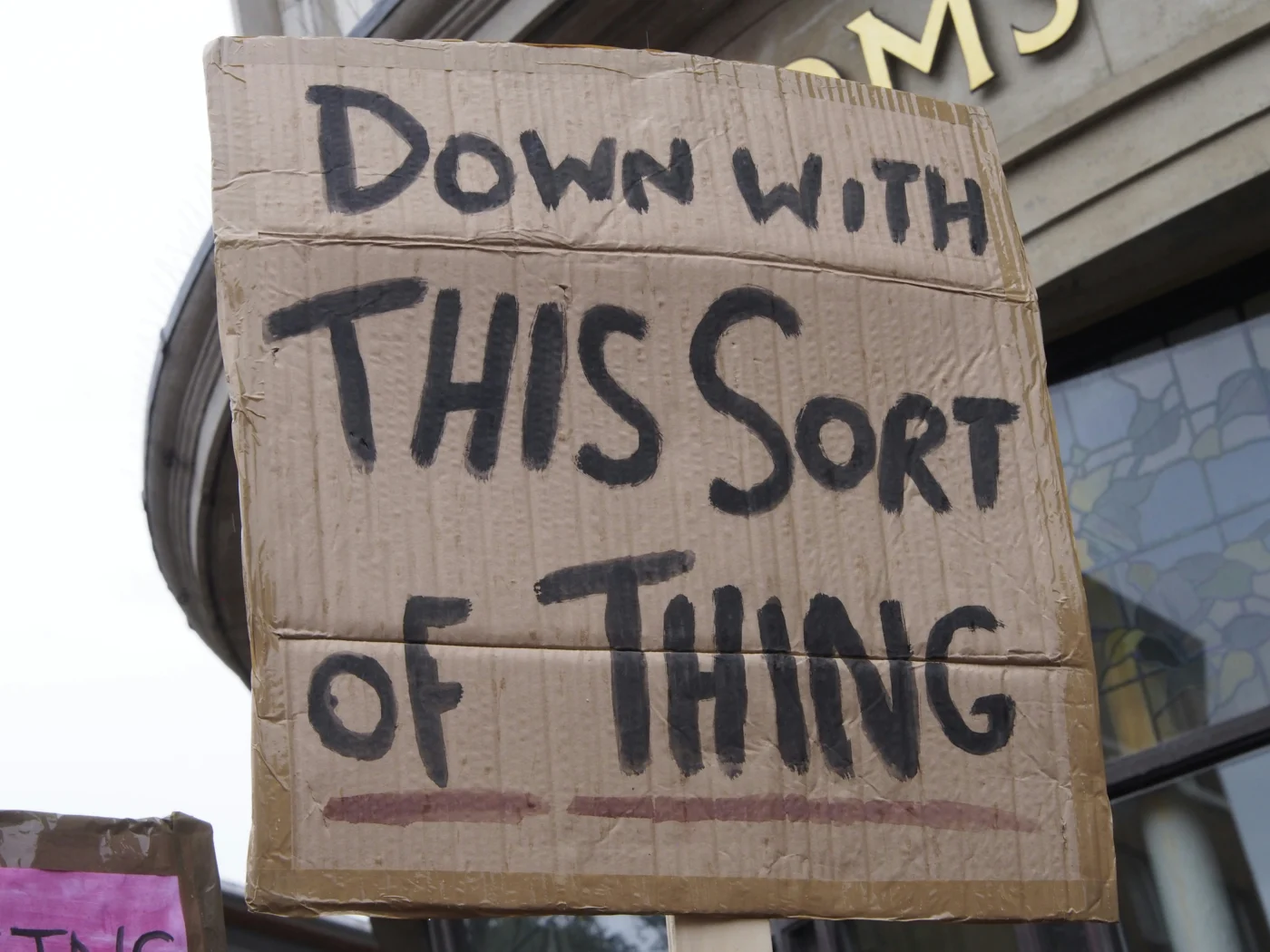
Something has gone badly wrong with British political discourse, and the elections on Thursday will be the first formal reckoning with it. Three threads run through the disorder, and they share a single pattern: a political and media establishment using manufactured crises, convenient attributions, and the deliberate conflation of dissent with hatred to avoid accountability for its own failures. The threads are distinct. The logic connecting them is not.
The boy who cried wolf (the wolf being Iran)
When a seventeen-year-old lad is found with a petrol can after ambulances have been torched, and when a man with evident and untreated mental illness carries out a random knife attack, an appropriate response should be to ask what social conditions produced these incidents and what failures of the state allowed them to reach that point. The response of Keir Starmer’s government and the Metropolitan Police Commissioner has been rather different. Look east, they say. Point at Tehran. Warn the IRGC.
It is a response that collapses under the slightest scrutiny. The Islamic Revolutionary Guard Corps is a sophisticated, well-resourced intelligence and paramilitary organisation. Its documented operations on British soil have involved targeted surveillance of specific dissidents, credible assassination plots against named individuals, and coordinated cyber operations. These are the methods of a professional intelligence service with clear strategic objectives. They are not the methods of an organisation that recruits disturbed teenagers and hands them a can of petrol and a lighter or matches, They are not an organisation that directs individuals in the grip of psychotic episodes toward random public violence. The attribution is not merely implausible. It is operationally absurd.
A misleading diversion is preferred to an honest assessment
The reason it keeps being reached for is not difficult to identify. A foreign adversary is infinitely more useful to a failing government than an honest domestic reckoning. If Iran is responsible, the response is a stern warning and a security briefing. If the actual causes are responsible – chronic underfunding of mental health services, the warehousing of traumatised asylum seekers in conditions of enforced idleness and despair, the absence of any meaningful integration pathway, then the response requires confronting years of political failure head-on.
Many of those carrying out apparently random acts of violence have arrived in Britain from active conflict zones. They carry trauma that would test the most robust mental health system in the world, and they are receiving almost nothing. The hotel stabbings in Glasgow were not inexplicable (in fact we know the man was unhappy and wanted to leave the UK). These events are the entirely predictable consequence of placing severely traumatised people (often from different ethnic, religious, and national backgrounds, with unresolved legal status, no meaningful activity to provide purpose, distraction or validation, and no therapeutic support) into confined, overcrowded hotel accommodation and hoping for the best. This is not a policy. It is the abdication of one, and it has a body count.
There is a further danger in the Iran reflex beyond the immediate policy failure. Credibility is a finite resource. When a government attributes every incident of disorder to foreign state actors, it degrades its own capacity to be believed on the occasions when the attribution might actually be warranted. Britain has faced genuine Iranian-linked threats. Those threats deserve to be taken seriously. But when the same language is deployed to describe a teenager with a petrol can and a planned IRGC assassination plot against a named dissident, the signal drowns in the noise. That confusion, in the end, serves nobody except those who wish to operate in the space between legitimate security concern and deranged political theatre.
The weapon called antisemitism
Antisemitism is a real and serious form of hatred with a catastrophic history, and it must be confronted wherever it genuinely exists. What is happening in British political life is something different: the systematic deployment of the accusation as a tool to shut down debate about Israeli state conduct – conduct that the International Court of Justice (ICJ) has repeatedly and unambiguously found to violate international law, and in doing so has devalued the term and the impact it once had.
The ICJ’s findings are not marginal or contested. The court has found that Israel is in breach of international law, that it is failing in its obligations as an occupying power to move toward ending the occupation as soon as practicable, and that Israel’s defence arguments (built on articles of international law to which it is itself a signatory) have not been upheld. These are findings of the principal judicial organ of the United Nations which is, in effect, the highest court in the world. They are not the opinions of protesters or partisans. Yet the British government has responded not by meeting its own statutory obligations (which require the investigation of war crimes and the referral of evidence to appropriate authorities) but by closing down the Home Office unit monitoring war crimes and directing the Metropolitan Police not to investigate British citizens who served in the IDF during operations that the ICJ (as well as the International Criminal Court (ICC)) has placed under legal scrutiny. These are not omissions. They are choices, and they are choices that require proper detailed examination and explanation.
A captured political establishment
The explanation that is never given officially is the one that appears most visible in practice: that the British government has aligned itself with a pro-Israel lobby whose operational method is to treat any criticism of Israeli state policy as evidence of antisemitism. This conflation is not merely intellectually dishonest. It is itself a form of harm, because it treats British Jewish citizens as a monolithic bloc whose identity is inseparable from the actions of a foreign state – which is precisely the kind of reductive thinking that bigots delivering genuine antisemitism depends upon.
The media has been a willing participant in this erasure. When broadcasters and newspapers seek a Jewish voice on Israel and Palestine, they reach reliably for the same figures: Jake Wallis Simons, editor of the Jewish Chronicle and a vigorous advocate for Israeli state positions; The Board of Deputies; and former Chief Rabbi Lord Mirvis, whose political interventions have consistently aligned with the pro-Israel lobby. These may be legitimate voices, however, they are not representative ones. They are selected because they say what the establishment wishes to hear, while the thousands of Jewish people who march regularly with Palestine solidarity movements, people who belong to organisations like Na’amod and Jewish Voice for Labour, who are among the most prominent voices calling for a ceasefire and an end to the occupation – are treated as peripheral, eccentric, or inconvenient. The Jewish community is not a monolith. Presenting it as one is not protection. It is its own form of distortion and risks increasing the scourge of antisemitism.
A reductio ad absurdum: Accusing a Jewish man of antisemitism
The third thread is where the strategy consumes itself. In the days immediately before Thursday’s elections, with polls suggesting that Zack Polanski’s Green Party is on course for a historic breakthrough and that Labour faces its worst results in decades, the attacks on Polanski have reached a pitch of desperation that has produced something close to farce.
Polanski is Jewish. He has, in his own words, had two people arrested for antisemitic actions against him in the past six weeks alone. The Times newspaper published what he described as a vile antisemitic cartoon targeting him personally. He has stated clearly that antisemitism and Jewish safety are not abstract concepts for him – they are his lived experience. And yet the charge being levelled against him, by Melanie Phillips, both verbally and in print, as well as echoed across the right-wing press and reflected in Labour’s attack dossier, is that he is inciting and allowing antisemitism and hatred.
The basis for this charge is that Polanski believes the Israeli state has committed atrocities in Gaza and is facilitating killings in the West Bank and East Jerusalem, and that he has said so publicly. The redoubtable Mick Lynch, the former RMT union leader, spoke for many when he pushed back plainly and directly on television. Polanski, Lynch said, was not inciting hatred against Jews and had never done so. In Lynch’s words: “He’s seeking to find a way where he can be an agent for peace, in my opinion. But he’s not inciting any hatred against Jews. I’ve never seen him do that” because, Lynch continued, Polanski believes the Israeli state has committed mass murder in Gaza and is facilitating the murder of hundreds of people on the West Bank. That, Lynch noted, was not antisemitism. It is a political position on the conduct of a state and one that (as noted earlier) is backed by evidence and statements by the ICJ.
Timing is everything
What makes the attack on Polanski so revealing is not merely that it is being made against a Jewish man. It is that it is being made at this precise moment, by precisely these actors, with a series of local and national (Wales and Scotland) elections on Thursday in which the Greens are threatening to take significant votes from Labour and the Conservatives alike. The timing is not coincidental. The desperation is clearly visible. And the logical consequence of the position being advanced – that a Jewish man who opposes Israeli state conduct is himself an antisemite – is a reductio ad absurdum that exposes this desperate strategy for what it is: not the defence of Jewish people, but the defence of a political position using Jewish people as its human shield.
Polanski himself identified this most clearly. Antisemitism is being weaponised to shut down criticism of the Israeli government, he said, and that weaponisation is itself a form of antisemitism, because it instrumentalises Jewish identity and Jewish suffering for political ends. He is right. And the fact that the response to him saying so has been to intensify the attacks rather than engage with the argument tells you everything you need to know about the good faith (or lack thereof) of those making them.
What Thursday will tell us . . .
The voters heading to the polls on Thursday have watched all of this. They have watched a government warn Iran about petrol cans while asylum seekers deteriorate in hotel rooms without support. They have watched statutory war crimes obligations quietly shelved. They have watched a Jewish man accused of antisemitism for opposing a military campaign that has killed tens of thousands of civilians. And they have watched an establishment media platform the same approved voices, week after week, to tell them that what they can see with their own eyes is not what it appears to be.
It’s entirely likely that the results will not be a verdict on any single issue. But they will reflect, in the aggregate, a profound and growing conviction that the political class is not merely failing to govern competently, it is actively suppressing the conversation that would make accountability possible. That suppression has a cost, and Thursday is part of the bill coming due.